(b) University of Leoben - Institute of Material Science and Testing of Plastics, A-8700 Leoben - Austria
(c) Zellform GmbH, A-4731 Prambachkirchen - Austria
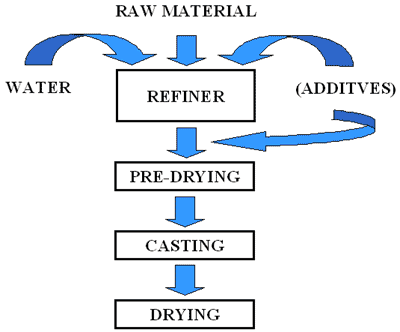
The development of Zelfo was based on a review on technologies for the production of papier mâche at the end of the 19th century. However, in contrast to papiermaché Zelfo does not contain any additional bonding agent. Potential raw materials for the production of Zelfo include various plants and wastes with a high cellulose content (e.g., hemp, flax, waste paper). The first production step is a refining process, in which the raw materials are simultaneously are hackled and ground and mixed with water. The result of this process is a microfiberpulp with a solid content of 1 to 15 m%, which is subsequently pre-dried, cast or molded into a final shape and dried. Due to the possible variations in raw materials and in the production process, properties of Zelfo can be varied systematically over a certain range. For example, values for density from 0.5 to 1.5 g/cm3, for tensile modulus from 1500 to 6550 MPa and for tensile strength from 7 to 55 MPa can be achieved. Thus, Zelfo is likely to compete with both conventional plastics and chipboard for certain applications.
INTRODUCTION
Starting point for the development of "Zelfo" was a review study on materials based on renewable resources and corresponding processing technologies, particularly of papier mâche, which gained importance in the second half of the 19th century. At that time papier mâche was used for a wide variety of applications including furniture, building and construction products, household appliances, music instruments, etc. At the beginning of the 20th century materials based on papier mâche were gradually replaced by Bakeliteâ and other plastics. While the process with papier mâche also included the addition of separate bonding agents, it was the aim of the development of Zelfo to obtain cellulose based materials without any additional bonding agent. Hence, extensive practical experiments were carried out to enhance the intrinsic bonding capability of the cellulose fibers. As a result, materials with reasonable mechanical properties fully based on renewable resources could be produced.
The purpose of this paper is to provide an overview of the production process and the range of basic mechanical properties of the Zelfo material class. The Zelfo property profiles are compared with those of typical commodity plastics and wood containing materials.
RAW MATERIALS AND PROCESSING
The range of potential raw materials for Zelfo includes a vast number of plants with high cellulose content such as hemp, flax, straw, reed, sugar cane, sisal and alike, as well as cellulose containing consumer and industrial waste products (e.g., old textiles and waste paper). The plant based renewable raw materials can be used directly as complete plants or as special fractions of various other plant preparation processes (e.g., hemp scrape, straw dust). All these raw materials can be used in pure form or in mixtures of various compositions.
A scheme of the production process of Zelfo is shown in Fig. 1. In a first step, the raw materials are simultaneously compounded with water and hackled in a refiner. To obtain the desired consistency microfiberpulp, a specific grinding energy of 0.35 to 1.75 kWh/kg dry substance is required. The microfiberpulp with a solid content of 1 to 15 m% is then exposed to a pre-drying process, which can take place with or without pressure.
The subsequent casting or molding process can be carried out in several steps. Each of these processing steps is usually followed by an additional interim drying stage whenever shapes with complicated geometry are to be produced. The casting and molding processing steps can take place without and with pressure, respectively. As Zelfo materials absorb relatively high amounts of moisture which substantially enhances the material flexibility, they may be reshaped to increase the dimensional precision of parts or components upon additional wetting and post-forming procedures. The wetting process can be carried out either by storing dry sheets or products in a steam saturated climate chamber for several hours up to days (depending on the maximum wall thickness and the necessary deformation) or by immersing these products in water. Subsequent drying hardens Zelfo again to previous values of density, stiffness and strength.
In general, moldability, density, stiffness and strength were found to increase with growing refinement of the cellulose containing raw material. However, best mechanical properties in terms of high stiffness and strength values can be achieved by addition of a certain amount of less refined longer cellulose fibers to the finely ground microfiberpulp. While the finely ground microfiberpulp in these mixtures apparently acts as a bonding agent, with higher density values reflecting a higher degree of compaction, the coarse cellulose fibers are believed to act as second phase reinforcement, similar to short fiber reinforced plastics.
Depending on the application, it may also be useful to add further additives before the refining process or to the microfiberpulp. Thus, Zelfo products with higher fire resistance, better insulation properties, different colors, etc. can be made.
To achieve porous materials of lower density for light weight parts and components, two possibilities exist. In one process route the microfiberpulp is frozen after the shaping process and subsequently dried. In the second process route propellants or ferment agents are added to the microfiberpulp to achieve a microstructure of a certain porosity. Further details of the production process are described elsewhere[1].
MATERIALS, MATERIAL MICROSTRUCTURE AND PROPERTIES
Materials
For the purpose of the present paper two material types of the Zelfo material class were investigated. The one material, designated Zelfo HG, was produced directly from hemp plants, the other material, designated Zelfo HZ, from refined hemp cellulose. Processing procedures and parameters for both materials were selected to achieve optimum mechanical properties.
Material Microstructure
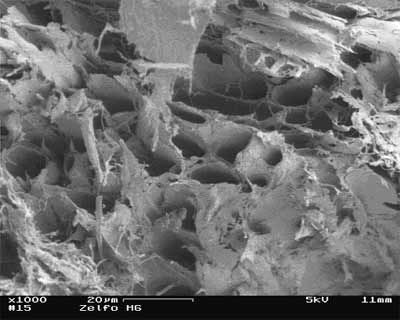
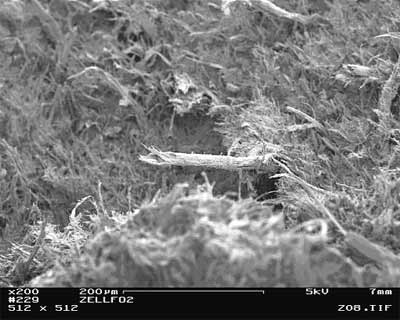
The material microstructure as observed on typical fracture surfaces is shown for both materials in Fig. 2. These micrographs were obtained by scanning electron microscopy (SEM) using a Zeiss SEM device of the type DSM 962 with an LaB6-cathode (Zeiss, Oberkochen, D), while the fracture surface of the lower density material Zelfo HG in Fig. 2a reflects a coarse microstructure with certain a degree of porosity associated with the use of unrefined hemp, the Fracture surface appearance and material microstructure of (a) Zelfo HG and (b) Zelfo HZ microstructure of the higher density material Zelfo HZ reveals a higher degree of compaction with more finely dispersed fibrils mainly due to the additional refining process of the hemp cellulose raw material.
Material Properties
To characterize the material properties of the two Zelfo types, appropriate specimens were machined from Zelfo sheets of approximately 4 mm thickness. With the exception of the Charpy impact specimens for Zelfo HZ (which were obtained from original sheets without surface grinding), all other specimens were obtained from sheets with ground surfaces to reflect the surface condition of typical commercial Zelfo products. The results of the various investigations performed on both Zelfo materials are listed in Table 1. All specimens were stored at 23°C and 50% r.h. for at least one week prior to testing. For comparison also provided in Table 1 are typical properties of other materials such as the commodity plastics high-density poly(ethlyene) (PE-HD) and unplasticized poly(vinylchloride) (PVC), and wood meal filled phenolic resin (PF-HM) and chipboard. The data for the latter materials were obtained from the appropriate literature. The properties listed in Table 1 will be discussed in more detail below.
Density [g/cm3] | Tensile Modulus [MPa] | Flexural [MPa] | Charpy Strength [MPa] | Impact Modulus [MPa] | Strength unnotched | Strength notched [kJ/m2] | |
Zelfo HG | 0.5 | 1500 | 7 | 17 | 1800 | 2 | 1 |
Zelfo HZ | 1.5 | 6550 | 55 | 95 | 9400 | 14 a) | 6 a) |
PE-HD | 0.95 | 25 b) | 1000 | - | - | c) | 15 |
PVC-U | 1.4 | 60 b) | 3000 | 100 | - | c) | > 2 |
PF-HM | 1.4 | 25 | - | > 70 | 7000 | > 6 | > 1.5 |
Chipboard | 0.7 | - | - | 18 | 1800 | - | - |
Density
The density range covered by Zelfo materials starts with Zelfo HG at 0.5 g/cm3 at the lower reaching up to 1.5 g/cm3 for Zelfo HZ at the upper end (it should also be mentioned that density values as low as 0.3 g/cm3 may be obtained for porous Zelfo types as discussed above; such materials, however, were not part of the present investigation). For comparison, at the lower end of the Zelfo density range, chipboard reveals a density of approximately 0.7 g/cm3, while PVC and PF-HM show density values of 1.4 g/cm3, close to the upper end of the range of Zelfo materials. PE-HD, with 0.95 g/cm3, shows a density in the mid-range of densities covered Zelfo materials.
Tensile properties
The tensile tests were carried out with an Instron 4505 universal electromechanical testing machine (Instron, High Wycombe, UK) according to ISO 527. Tensile modulus values of Zelfo HG and Zelfo HZ with 1500 MPa and 6550 MPa, respectively, differ by a factor of 4, reflecting the differences in density. These values compare very favorably with those of the other materials (PE-HD: 1000 MPa; PVC: 3000 MPa).
In terms of tensile strength, the differences between Zelfo HG and Zelfo HZ are significantly enhanced, revealing a difference of a factor of 8 (Zelfo HG: 7 MPa; Zelfo HZ: 55 MPa). Nevertheless, the tensile strength values for Zelfo materials are also comparable to those of the other materials, at least for the higher density range (PE-HD: 25 MPa; PVC: 60 MPa; PF-HM: 25 MPa). At this point it should also be mentioned that specimens of Zelfo with unground surfaces reveal significantly higher tensile strength values, with a tensile strength for Zelfo HZ of 75 MPa.
Flexural Properties
Flexural tests were carried out with an Instron 4505 testing machine according to ISO 178. Due to possible border effects and non-linear elastic behavior flexural strength and flexural modulus of Zelfo is higher then the analog tensile properties. The measured flexural strength is 95 MPa and 17 MPa, the flexural modulus 9400 MPa and 1800 MPa for Zelfo HZ and Zelfo HG respectively. PF-HM comes close to the values for Zelfo HZ with 70 MPa and 7000 MPa for strength and modulus respectively, while the chipboard has flexural properties nearly as Zelfo HG. PVC-U’s flexural strength of 100 MPa is little bit higher than Zelfo HZ’s.
Impact Properties
Impact tests were carried out with a Ceast Resil 25 pendulum (Ceast Spa, Turin, I) following ISO 179. Zelfo HZ reached a Charpy impact strength of 14 kJ/m2 and 6 kJ/m2 for unnotched and notched ungrinded specimens respectively. The drop by factor two is also observed with Zelfo HG, having an impact strength of 2 kJ/m2 and 1 kJ/m2, unnotched and notched respectively. Unnotched PE-HD and PVC-U do not fracture under the normative conditions. PE-HD has with 15 kJ/m2 a much higher impact strength than Zelfo, PVC-U is with 2 kJ/m2 superior to Zelfo HG, but not better than Zelfo HZ. The phenolic resin has impact properties between Zelfo HG and Zelfo HZ, with an impact strength of 6 kJ/m2 for unnotched and 1,5 kJ/m2 for notched specimens.
Dependency of Flexural Properties on the Immersion Time in Water
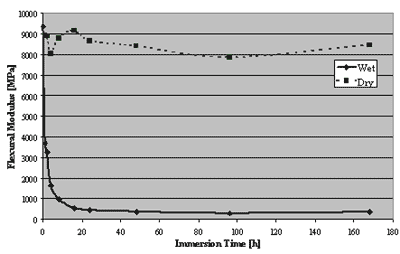
These tests were carried out following ISO 175 and ISO 178, using an Instron 4505 testing machine. Zelfo HZ specimens were immersed in distilled water at 23°C. After 1, 2, 4, 8, 16, 24, 48, 96 and 168 h specimens were taken out of the water. Half of these specimens undergone flexural tests, the other half was dried at 23/50 till constant weight was achieved and tested afterwards. Figure 3 shows the dependency of the flexural modulus of the wet and dry specimens on the immersion time. It is clearly visible that the flexural modulus decreases very fast, after one day the minimum value of approximately 500 MPa is nearly reached, about one tenth of the starting value of 9400 MPa. What is the most interesting point in this figure, it was already stated in the raw materials and processing chapter, is that the dried specimens regain their old stiffness, independent of the immersion time. Deviations from this statement, visible in figure 3, are due to a high statistical bandwidth.
Conclusions
The comparison of the mechanical properties of Zelfo with common plastics and chipboard shows that Zelfo is able to compete with these materials. Zelfo’s biggest advantage is likely to be it’s fully biodegradability, which makes it very interesting for many applications. To strengthen the ecological argumentation basis it would be very useful to make a life-cycle-assessment for Zelfo and it’s competitors. Furthermore, intensive research on structure-property-relationships for Zelfo would be very helpful to optimize this material for special applications.
References  [1.] Patentschrift [2.] B. Carlowitz, Kunststoff Tabellen, 1986 [3.] H. Domininghaus, Die Kunststoffe und ihre Eigenschaften, 1992 [4.] Österreichische Homogenholz, Data sheet, 1999